
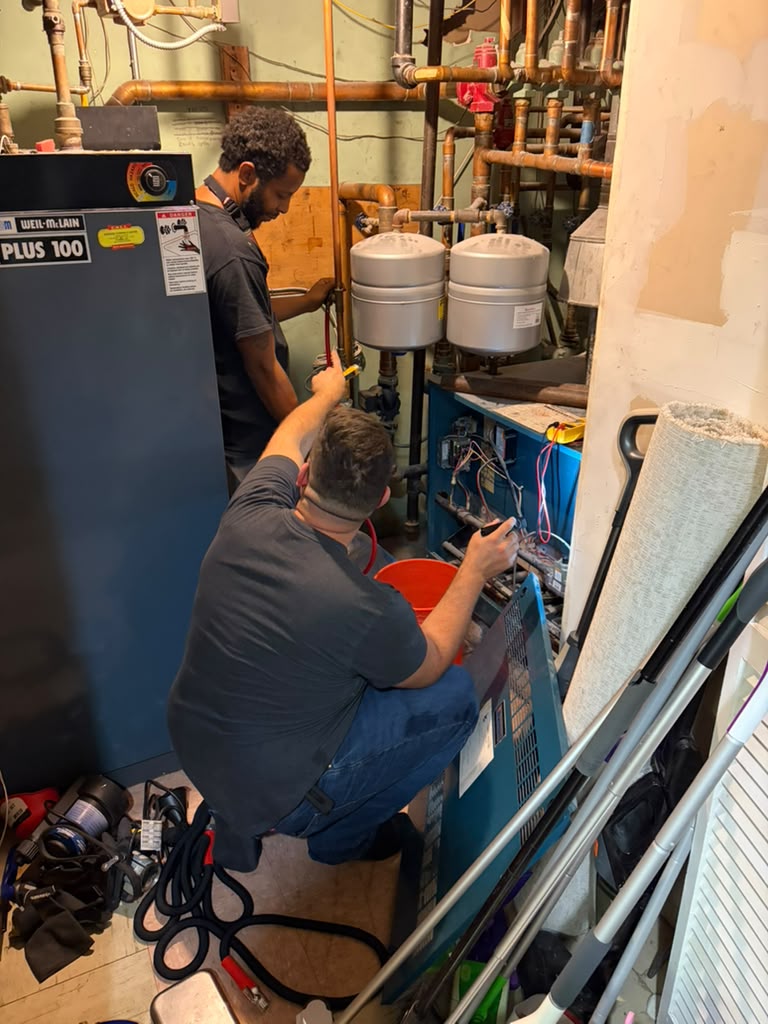
The best way to prepare your heating system for winter is to have it professionally tuned up before the cold arrives, run it once on a mild day to make sure it works, and check that your carbon monoxide detectors and outdoor vents are clear. That is the short answer. The rest of this post explains why, using real calls our technicians at Gold Star Mechanical have handled across Nassau County and Brooklyn.
Here is what we see every year. During mild fall weeks, we might get no heating calls at all. Then the first real cold snap hits, and in a single day we can get 15 to 20 or more calls from people with no heat. Most of those calls could have been avoided with a little preparation.
The heating problems we see most (and what causes them)
Most early-season no-heat calls come down to a short list of problems that build up slowly over the summer and fall. Here is what our technicians find most often.
“The heat is on, but it’s blowing cold air.” On a furnace, this usually means the burner keeps shutting off. The two most common causes are:
- A dirty flame sensor. The flame sensor is a small metal rod that confirms the burner actually lit. When it gets coated with buildup, the furnace can’t “see” the flame and shuts the gas off as a safety precaution. The blower keeps running, so you feel cold air. Cleaning it is a quick fix during a tune-up, but it’s a no-heat emergency on a 20-degree night.
- A clogged filter that causes overheating. A filter that hasn’t been changed restricts airflow. The furnace runs hot, trips its high-limit safety switch, and shuts the burner off. A filter swap that costs a few dollars can prevent it.
Fan motors going out. Blower motors work hard, and restricted airflow from dirty filters adds strain over time. A failing motor often shows warning signs, like humming, slow starts, or weak airflow, that a technician can catch before it quits completely.
Boiler zones that won’t heat. Homes with boilers and baseboard heat have their own set of problems:
- Air in the lines. A customer recently called us with no heat. The boiler was fine, but air had collected in the system and was blocking hot water from moving through the pipes. Our technician purged the air from the water lines and the heat came back.
- Bad zone valves. Many homes in our area have several heating zones, each controlled by its own valve. When a zone valve fails to open, or its end switch doesn’t signal the boiler to fire, that part of the house stays cold while the rest is fine. Valves that sit unused all summer are especially likely to stick.
What you can do yourself this week
You don’t need tools or training for these. They take a few minutes and catch the problems that cause most emergency calls.
- Turn your heat on before it gets cold. This is the most important step. Pick a mild day, raise the thermostat a few degrees, and make sure warm air or warm baseboards follow within a few minutes. One of our customers did this recently and found the thermostat wasn’t working. Because it was caught early, we fixed it before it became a bigger problem, and before the family was sitting in a cold house waiting for a technician during the rush.
- Check or change your filter. If you have a furnace or air handler, pull the filter and hold it up to the light. If you can’t see through it, replace it.
- Clear your outdoor vents. High-efficiency furnaces and boilers often vent through a side wall instead of a chimney. Keep those pipes clear of leaves now, and of snow and ice all winter. A blocked vent can push carbon monoxide back into your home.
- Test your carbon monoxide detectors. Press the test button, replace batteries, and check the date on the back. CO detectors wear out and need to be replaced periodically, so follow the manufacturer’s replacement date.
- Clear the area around your equipment. Boxes, storage, and laundry piled near a furnace or boiler are a fire hazard. They also block airflow and make service harder. Keep anything that can burn well away from your heating equipment.
What to leave to a professional: anything involving gas lines, burners, wiring, or opening up the boiler or furnace. Bleeding a single radiator is one thing. Purging air from a whole boiler system, adjusting system pressure, or replacing a zone valve is work for a licensed technician.
Carbon monoxide: the danger you can’t see
A heating system can keep your house warm while it slowly poisons the people inside. Carbon monoxide (CO) has no color, smell, or taste. A system that seems to be working fine is not proof that it’s safe.
Case study: the CO alarm no one could explain. An older woman we serve kept hearing her carbon monoxide detector go off, and no one could figure out why. Her heating unit itself was in good condition. Our technician kept looking past the unit and, about five feet away, found the problem: the flue pipe, which carries exhaust gases out of the house, was heavily corroded. Exhaust was escaping into her home. We had to redo the venting completely.
Two lessons from that call. First, her CO detector did its job, and it may have saved her life. Second, an inspection has to cover the whole system, not just the box in the basement. That is why our boiler tune-up includes inspecting the flue pipe and chimney connection, checking combustion air, and testing for carbon monoxide.
We’ve also found cracked heat exchangers producing high carbon monoxide levels in homes where the heat was still working normally. A heat exchanger is the part that separates the flame and exhaust from the air or water that heats your home. When it cracks, exhaust can get into your living space.
Watch out for bypassed safety switches. Heating systems are built with safety switches that shut the burner off before conditions become dangerous. The high-limit switch shuts it off when the system overheats, which protects the heat exchanger from the kind of stress that can crack it. The rollout switch shuts it off when flames roll out of the combustion chamber, which can happen when exhaust isn’t venting properly. When these switches keep tripping, they’re telling you something is wrong.
We have walked into multiple homes where someone had “jumped out” the rollout switch or high-limit switch. That means they wired around it so the heat would keep running. It gets the heat back on in the short term, but it removes the protection that keeps the system from overheating or venting exhaust into the house. That can be very dangerous. The right fix is to find out why the switch is tripping and repair the cause.
This is one of the biggest reasons to hire a licensed and insured company. We don’t take shortcuts like that. If a safety device is tripping, we find out why and fix the real problem.
In New York, CO detectors are the law. Under New York State’s Amanda’s Law, which took effect February 22, 2010, homes with fuel-burning appliances must have carbon monoxide detectors. Homes built before January 1, 2008 may use battery-powered alarms, and existing one- and two-family homes need at least one detector on the lowest floor with a sleeping area (NY State Senate). That is the legal minimum. The New York State Assembly recommends a detector near bedrooms and on every level of the home (NY Assembly), and we agree. New York City has its own additional rules, so Brooklyn homeowners and landlords should check those too.
If your CO alarm goes off, don’t assume it’s a false alarm. Get everyone out of the house, call 911, and have your heating system inspected before you use it again.
Away for the winter? Know about a problem before it becomes a flood
Many of our customers in the Five Towns and Brooklyn travel during the winter or own homes that sit empty for weeks. If the heat fails while no one is home, pipes can freeze and burst. The result is no longer a service call. It’s water damage, torn-out walls, and major construction.
The simplest protection we recommend is a Wi-Fi temperature sensor. It sits in your home and sends an alert to your phone if the temperature drops below a level you set. Instead of finding out about a problem when you get home, you find out the moment the heat stops, while it is still a routine repair. We have helped customers monitor their homes remotely this way, and it gives them real peace of mind while they’re away.
These sensors are inexpensive and widely available. Here is one we recommend: GoveeLife Thermometer Hygrometer with temperature alerts.
Before you leave for an extended trip, we also recommend:
- Scheduling your tune-up before you go, not after you get back
- Keeping the thermostat at a safe minimum rather than turning the heat off
- Shutting off the main water supply to the house, so a burst pipe or failed fitting can’t turn into a major leak while no one is home. If you have a boiler, ask us first: the boiler’s water feed often comes from the same supply, and in some homes it needs to stay on so the boiler doesn’t shut down. The same goes for homes with fire sprinklers.
- Leaving a key and your contact information with someone who can let a technician in
What a professional heating tune-up covers
A DIY check catches the obvious problems. A professional tune-up catches the ones that cause breakdowns and safety hazards. Here is exactly what Gold Star Mechanical’s preventative maintenance includes.
Boiler tune-up: a 19-point inspection in four categories
1. Boiler and burner
- Inspect and clean the burner assembly
- Inspect the ignition system
- Check gas pressure
- Inspect the heat exchanger
2. Venting and safety
- Inspect the flue pipe and chimney connection
- Check combustion air
- Test for carbon monoxide
- Verify safety controls
3. Hydronic system (the pipes, pumps, and valves that move hot water)
- Check circulator pumps
- Inspect the expansion tank
- Check system pressure
- Inspect zone valves
- Check the pressure relief valve
- Inspect for water leaks
4. Baseboard and zones
- Verify thermostats
- Test each heating zone
- Check baseboards for proper heat
- Check for air in the system
- Bleed or purge zones if necessary (extensive purging is billed as additional work)
If your boiler feeds a hydro-air system, where hot water from the boiler heats air that is blown through ducts, we also service each indoor air handler.
Furnace and forced-air tune-up
- Full system inspection
- Safety checks: carbon monoxide, gas leaks, and electrical connections
- Efficiency testing
- Check and replace standard filters
- Check all electrical connections
- Check and clear condensate drains
- Clean the flame sensor
- Inspect the blower motor and capacitor
- Inspect the igniter and high-limit switch
Humidifier pad changes and humidifier or dehumidifier service are available at an additional charge.
Every home is different, so call us for a quote based on your system and number of zones.
When to schedule: the open-window rule
Here’s an easy way to remember it: when you open your windows, call us. The first days you open the windows to cool the house or let in fresh air, in spring or fall, are the right time to book preventative maintenance. The weather is mild, you don’t need the system yet, and there’s time to fix anything we find.
If you’re reading this and haven’t had your tune-up yet, schedule it now. Don’t wait for the first freezing night. That’s when we go from almost no service calls to 15 or 20 or more a day, and everyone who waited is calling at once.
Customers with a Gold Star maintenance agreement receive priority scheduling.
Why homeowners trust Gold Star Mechanical
We treat every customer the way we’d want our own mother treated. In practice, that means:
- We stand behind our work. If something isn’t right, we come back and make it right.
- Real support behind every visit. Our back office handles scheduling, follow-up, and questions, so you’re never left wondering what happens next.
- Licensed, certified, and insured.
- Experience with complex systems. We work in high-end homes and commercial buildings, including multi-zone boilers, hydro-air systems, and furnaces, and we handle preventative maintenance, repairs, system replacements, and new construction.
Gold Star Mechanical is based in Hewlett, NY, and serves residential and commercial customers throughout Nassau County, including the Five Towns, as well as Brooklyn. We handle all heating, cooling, and ventilation needs, from single-zone boilers to multi-zone and hydro-air systems in large homes and commercial buildings.
Ready to get your heating system ready for winter? Call us at 516-284-6866 or request service online to schedule your tune-up.
And when winter is over, we’re here for the rest of the year too. For all your heating, cooling, and ventilation needs, from routine maintenance and repairs to full system replacements, call Gold Star Mechanical.